Bet you never thought you’d see that subject line from me, did you?!
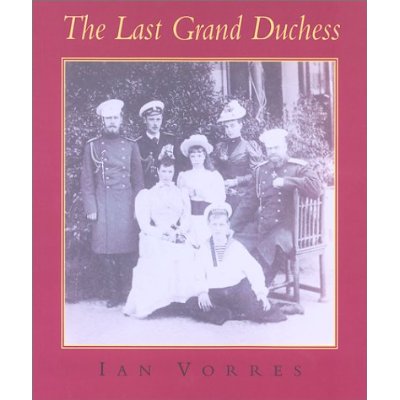
I just finished reading The Last Grand Duchess by Ian Vorres. Essentially, the last Romanov Grand Duchess, Olga Alexandrovna (youngest sister of Nicholas II), had a series of conversations with the author before her death in 1960, with the understanding that he would write her memoirs. The result is a sort of biography/memoir blend, because Vorres has done supplemental research and also discusses some of his own reactions.
While I wouldn’t recommend this book for anyone who isn’t somewhat familiar with the main players and events, it’s a must-read for those intrigued by all things Romanov. Olga, unlike the rest of the family and aristocracy, liked and sympathized with Alexandra. She also discusses Anna Anderson, Rasputin, and various rumors about her brother and sister-in-law. She’s not objective, of course (but who is?), but she presents quite different perspectives than many writers about the Romanovs, both at the time and since. In many cases, she has more firsthand knowledge for her claims than detractors have.
From a research perspective (because I’m writing about this era in my new novel), I was interested by Olga’s adamant condemnation of Rasputin’s assassins, Prince Felix Yussupov and Grand Duke Dmitri Pavlovich. Both of them will make cameos in my story, so I’m greedy for all the information and insight I can get.
OK, now on to the love story…bet you thought I forgot, huh?
Olga was married at age 19 to a much older cousin whom everyone knew had no interest in women. Three years later, she met Colonel Nicholas Koulikovsky, a friend of her brother, Grand Duke Michael. She said their eyes met and they both fell in love at first sight–which sounds cheesy, but what follows proves it wasn’t. Her husband, who had never consummated the marriage with her, refused to give her a divorce. Instead, he invited Koulikovsky to become one of his aide-des-camps. The three of them lived in the same house for nearly 15 years, and during that time, the grand duchess and the colonel remained in love. Vorres believes, however, that they never became lovers, both because of Olga’s devotion to her religious beliefs and because of the risk of pregnancy. Apparently everyone would have known any children she had weren’t her husband’s, but he would have had legal claim to them (and leverage over her). And in St. Petersburg, a hotbed of gossip, apparently no one had any inkling of the relationship between Olga and Nicholas.
After Russia joined World War I, the colonel was sent to the front with his regiment. Olga had no desire to remain in St. Petersburg without him, so she also went to the front as a nurse. She worked in Kiev for two years, and then he came to visit her on leave. They spent a week together, after which she returned to St. Petersburg and demanded an annulment from her husband. She and Nicholas were married in a small, private ceremony, and because he was a commoner, she forfeited her royal status.
Through the next tumultuous years, Olga and Nicholas had two sons. They were imprisoned in the Crimea with Olga’s mother, the Dowager Empress Marie, and various other relatives, although as commoners the Koulikovskys had more freedom than anyone else in the family. Ultimately they escaped and spent eight years exiled in Denmark with Olga’s mother, who consistently snubbed her son-in-law and demanded much of her daughter’s time and attention. (The Dowager Empress sounds like a bitch, frankly.) Apparently, Nicholas tolerated Marie’s treatment of him and her power games with grace and without complaint.
After Marie’s death, the Koulikovskys purchased a farm in Denmark and quite happily farmed and raised their sons. Then, as World War II began, it became too dangerous for Olga in Europe; the Soviet government was hatching plots to kidnap and assassinate her. So the family emigrated to Canada, and Olga and Nicholas continued to farm until they became too old and infirm, at which point they moved into a small cottage. When his health failed, she nursed him until he died. Vorres believes she lost her own will to live after that, and she died two and a half years later.
While you might think marrying a Romanov would be prestigious, it brought little but hardship to Nicholas Koulikovsky, according to Vorres. They had to flee for their lives more than once; they had little money much of the time; they had to deal with reporters looking in their windows and with a parade of Anastasia and Alexis imposters. Whatever bond was forged between them when “their eyes met” proved amazingly strong and enduring. I’m a cynic, but this is a beautiful story, even more so for being true.
Also, interestingly, Olga was no great beauty. Elsewhere I’ve seen her described as “plain,” and one might even say ugly.
As another interesting footnote, Nicholas II and Alexandra also married for love rather than political expediency. I wouldn’t go as far as some have–to lay the blame for the downfall of the Romanovs squarely on Alexandra–but certainly their combination of personalities was particularly ill-suited to deal with the challenges facing their reign.
 Monique Bos
Leave a comment