
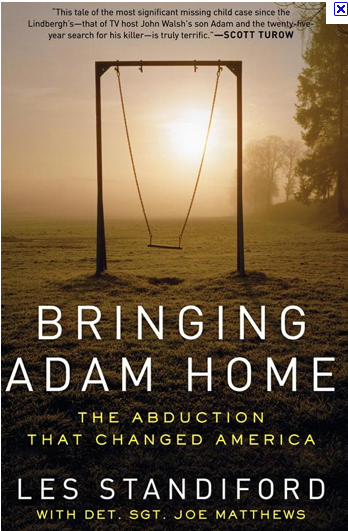
I just finished reading two books about the Adam Walsh case: Tears of Rage by John Walsh and Susan Schindehette, and Bringing Adam Home by Les Standifer with Detective Joe Matthews. The first is a 1997 memoir by Adam’s father, John, who since his son’s kidnapping and murder in 1981 has become a high-profile, extremely effective advocate of children’s and victims’ rights, as well as hosting America’s Most Wanted. The second book, released in 2011, follows the years-long investigation by Matthews, originally called in as a polygrapher when Adam disappeared. Years later, he became a friend of the Walshes, and ultimately they asked him to try to solve Adam’s murder. Tracking down 27-year-old evidence and sifting through calls to tip lines, he finally was able to confirm that longtime suspect Otis Toole had indeed killed Adam.
Both books are a case study in how not to effectively solve a crime, although Walsh tries hard to be diplomatic. A small-town police department with an inexperienced detective botched the investigation, not only through their ignorance but through an almost inexplicable hubris: They rejected help from larger, neighboring jurisdictions; refused to request FBI help; dismissed Toole’s multiple confessions; focused on a suspect who had an alibi and had been cleared by a polygraph; misrepresented information in the official files; lost or misplaced valuable pieces of evidence and information; and, egregiously, torpedoed the careers of cops in different jurisdictions who tried to help solve the case.
Also remarkable is how much things have changed since 1981–when 6-year-old Adam disappeared from a Sears where he had accompanied his mom–and how much that’s directly due to the Walshes’ efforts. John Walsh himself says he doesn’t know if losing Adam served a greater good, per se (he seems to recognize that such questions could make him crazy), but he does feel strongly that he and his wife have helped ensure that Adam’s death wasn’t in vain.
 Monique Bos
Leave a comment