I’ve watched the Olympics more this summer than I have since I was ten. First things first, I have a few gripes:
- Has water polo gained some sort of popularity about which I am completely ignorant? Is there a valid reason that NBC ate up huge chunks of their afternoon broadcasts with water polo matches at the expense of every other sport anyone might possibly want to see?
- I wish both campaigns had declared a moratorium on advertising during the Olympics. I have commercials from both sides practically memorized, and believe me, this is not stuff I want in my brain. In the spirit of global cooperation or whatever, couldn’t we have had politics-free commercial breaks? (Oh, and half as many commercial breaks overall, as long as I’m registering complaints.)
- I miss the days when athletes had to be amateurs in order to compete. Honestly? I don’t care what kind of razor Ryan Lochte (it is Ryan, right? or is it Chad?) uses, or at least gets paid more money than I have seen heretofore in my life to say he uses. I don’t care who is promoting what kind of deodorant. I don’t care who some athlete likes as a presidential candidate. I want to watch the sports!
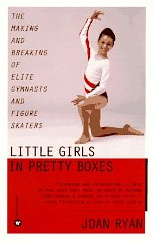
Okay, crankiness aside. During the opening days of the Olympics, I read the book Little Girls in Pretty Boxes: The Making and Breaking of Elite Gymnasts and Figure Skaters by Joan Ryan. It’s a thought-provoking and troubling account. Ryan interviews a variety of athletes, coaches, and family members. She tells horrifying stories of gymnasts breaking their necks and becoming paralyzed, dying from injuries, developing serious and even fatal eating disorders, and withering under verbal abuse from coaches and harsh training regimens. She talks about the dedication, money, and work that go into developing an elite gymnast or figure skater, the emphasis on appearance, and the way an entire career can be derailed in a second by an injury or one less-than-perfect performance. She also describes many instances of athletes being forced to compete with broken wrists, ankles, toes, even with stress fractures in their necks.
Among the coaches Ryan–and many of her interviewees–seem to consider the most abusive and demanding are Bela and Marta Karolyi. Ryan provides numerous stories and quotes detailing how hard the couple push their gymnasts, how they essentially force girls to compete with injuries, how Bela verbally abuses the girls and tells them how fat they are, how the couple rigidly control gymnasts’ food intake at competitions, and how the gym rums on a system of favoritism that has everyone walking on eggshells.
This book was published in 1996, and I realize some things have changed since then. For example, the Olympics have imposed an age limit, so girls younger than 15 (they must turn 16 during the calendar year in which they compete) cannot participate. We saw women ages 24 and even 37 compete this time around, along with the teenagers. I hope some of the other issues Ryan discusses–the fat comments, the emphasis on little-girl appearance, the physical risks–have been addressed. I don’t know whether they have, nor have I looked into that at all.
And I still watched the gymnastics–both men’s and women’s–and enjoyed the performances. Some were absolute perfection. But every time I saw Bela or Marta Karolyi, my stomach curdled a little. Every time I saw an athlete competing with a wrapped wrist or ankle, I cringed. Reading this book definitely gave me a deeper understanding of gymnastics (which the book focuses on far more extensively than on figure skating) and much food for thought.
Finally, a few notes on sportsmanship (sportswomanship?) in the competitions:
I know other people have commented about the female Russian gymnasts. And in a way, I don’t know if it’s fair to criticize them because I don’t know what sorts of cultural expectations, pressures, and ramifications they face. During the team competition, I felt awful for them with their series of missteps and falls. Then they cried and pouted through the awards ceremony, even though they still earned a silver medal. SILVER. We saw profiles of plenty of athletes from other countries who were thrilled just to be in the Olympics, just to have the chance to compete. And here are these girls, acting snotty, apparently possessed of such a strong sense of entitlement that they can barely be civil because they didn’t win the gold. By the last competition, I wanted Viktoria Komova in particular to do badly, which she did. Maybe I am not a nice person.
In all fairness, I should add that the U.S.’ McKayla Maroney was criticized for the same poor attitude after she fell and earned “only” a silver medal in vault. That’s the one women’s competition I missed, so this is hearsay. But I thought I should bring it up so I don’t sound xenophobic.
On the other hand, American men’s gymnast Sam Mikulak has received well-deserved accolades for his attitude during the vault competition, where he finished fifth. He didn’t seem remotely upset. Instead he stood on the sidelines cheering the gymnasts (from other countries, no less) who followed him. He appeared genuinely impressed by their skill and congratulated them enthusiastically when they returned to the sidelines. Of course I can’t read his mind, but my impression was that he was honored and thrilled to see the achievements of his competitors, that his delight in their skills and his excitement at being in the Olympics far overwhelmed any sense of personal disappointment. I realize there’s probably a PR element involved in some of the Americans’ seemingly gracious conduct, but Mikulak’s enthusiasm and encouragement were obviously genuine. He stood there beaming as he congratulated men who scored higher marks than he did and knocked him out of the medal competition. It was awesome. I have never seen someone lose so gracefully and with such authentic goodwill.
Another awesome moment was when Kirani James–a sprinter who won the first gold medal ever for Grenada–honored Oscar Pistorius, the South African man whose legs were both amputated and who runs on artificial blades. If I recall/ understand correctly, Pistorius placed highly enough in a qualifying meet to run in the semifinal but finished last in that race. James won the heat, and he immediately went to Pistorius, congratulated him, and initiated a trade of numbers (the tags or whatever they wear pinned to the fronts of their shirts). Then they hugged. It seemed like a wonderful moment, another gracious acknowledgment of accomplishment and mutual respect.
And that, folks, is a wrap. There’s a quirky little Zuli-cat vying for my attention, so I’m going to go lavish her with affection and then admire the Olympic-worthy feats of speed, locomotion, and gymnastics she and her sister Gorey execute flawlessly.
 Monique Bos
Leave a comment