I discovered Lloyd Alexander’s “Chronicles of Prydain” in my elementary school library when I was ten or eleven. I eagerly followed Taran the Assistant Pig-Keeper through five books’ worth of adventures, watching him grow from an impulsive, hot-tempered boy to a wise and seasoned leader. I also loved his companions. Gurgi, neither human nor beast, immediately captured my heart, and I was gratified to see how kindness transformed him from a cringing, thieving outcast into a loyal ally and valued friend. Coll the turnip farmer had a surprising history, and if Dallben was the mightiest enchanter in Prydain, he was also the drowsiest. The Princess Eilonwy of the red-gold hair was unlike any other princess I’d encountered in fiction: a feisty chatterbox who insisted on tagging along with the men to war, even when they tried to force her to stay home, and whose acerbically delivered common sense saved the day more than once. And the series villain — Arawn, death-lord of Annuvin, with his legions of Huntsmen and immortal Cauldron-Born — was a foe so chilling even Hannibal Lecter seems benign by comparison.
In the fall of 2014, I went in search of hardcover copies of the Prydain books (to replace well-loved paperbacks that had started to shed pages), and I was thrilled to see that Henry Holt was reissuing the series in beautiful cloth-bound editions to commemorate their 50th anniversary. I had to be patient, as they released only one volume per year until December 2017, when both Taran Wanderer and The High King (the fourth and fifth books, respectively) came out together. Over the past few weeks, I’ve had the delight of rereading the full series.

Unlike a lot of well-loved children’s books, the Prydain series doesn’t seem to have the kind of name recognition I would expect. Almost invariably, when I say, “The Chronicles of Prydain…you know, Lloyd Alexander’s books…you know, Taran and Gurgi and the oracular pig?” I am met with blank looks. (Author Tom Angleberger recounts similar frustrations in his foreword to the 50th anniversary edition of The Castle of Llyr.) Even Disney’s animated version of the second book, The Black Cauldron (1985), seems to have faded into obscurity. But people obviously do read and love the series, enough that in these days of ebooks the publisher decided that reissuing them in beautifully designed new editions was a financially viable proposition. And from the forewords, it’s clear that the goings-on in Prydain have influenced generations of bestselling and award-winning young adult novelists.
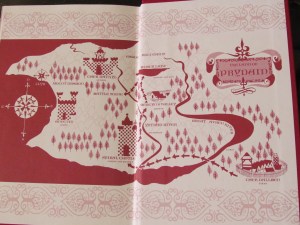
(Above is the map from The Book of Three.)
Alexander himself claimed to be inspired by Welsh legend — the source of various character names and places, such as Arawn and Annwfyn — but said he allowed his stories to develop organically without trying to conform to previous iterations of the myths. I don’t know whether he also recognized Tolkien as an influence, but parallels to the Lord of the Rings are evident, not only in the way various mythologies linger in the shadows, but particularly in the very bittersweet resolutions to both series. Spoiler alerts: The good side triumphs, but things don’t return to the way they were before. Not only have the characters’ identities been forged through loss and struggle and hardship, but the realms themselves are irrevocably changed. Magic might be required to defeat the likes of Arawn and Sauron, but rebuilding society takes the hard work and sacrifice, practicality and common sense of ordinary people.

These books remind us that good wins, but not without a (sometimes very steep) price. They affirm a moral order, a clear distinction between right and wrong, kindness and cruelty, love and hate, creation and destruction. They show us the importance of compassion, whether the recipient is Gurgi or Gollum. And they remind us that no one, not even an Assistant Pig-Keeper, is too small or insignificant to matter.


 Monique Bos
Leave a comment